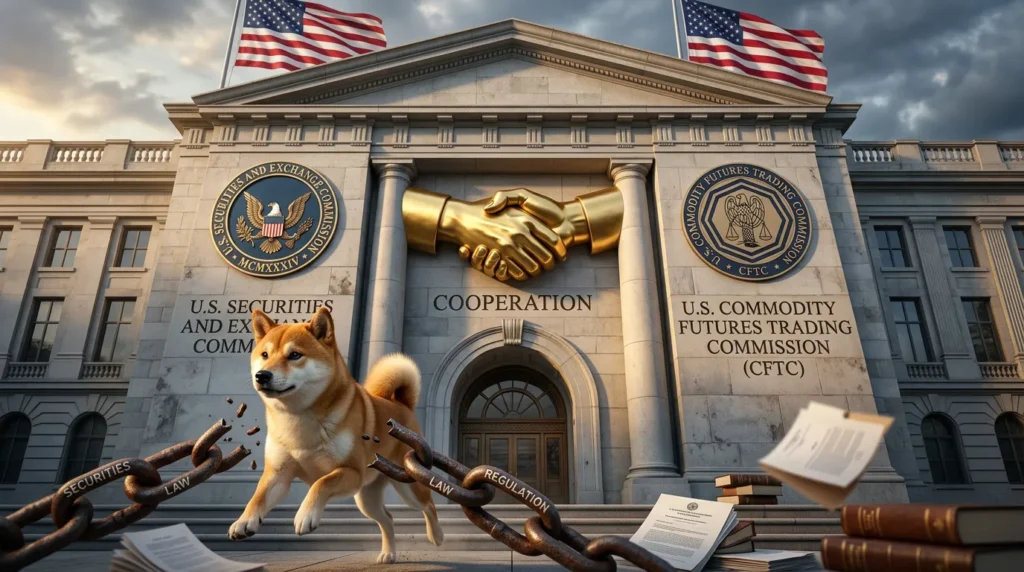
In a week already packed with market volatility and mixed sentiment signals, March 11, 2026 delivered what may be the most structurally significant regulatory development in Dogecoin’s 12-year history. The U.S. Securities and Exchange Commission and the Commodity Futures Trading Commission signed a landmark Memorandum of Understanding — formally ending years of jurisdictional conflict between the two agencies and establishing a joint framework for crypto oversight. For Dogecoin specifically, the implications are immediate and concrete: the SEC has already clarified that memecoins are not securities, placing DOGE firmly outside the most burdensome regulatory category and under a clearer — and more favorable — legal classification going forward.
That headline stands alongside a striking paradox in DOGE’s current market sentiment: the Fear & Greed Index sits at an extreme fear reading of 19, yet 69.4% of retail traders on Binance are actively holding long positions on DOGE — a divergence between headline fear and actual positioning that seasoned market observers know well as a potential contrarian signal. Meanwhile, the Dogecoin community is preparing for one of its most visible cultural moments of the year as a DOGE-branded race car gears up for the Indianapolis 500 — while raising funds for critically ill newborns.
This article is for informational purposes only and does not constitute financial advice.
The SEC-CFTC MOU: What Happened and Why It Matters for DOGE
On March 11, 2026, SEC Chairman Paul S. Atkins and CFTC Chairman Michael S. Selig signed a Memorandum of Understanding that formally establishes coordinated oversight of the cryptocurrency sector between the two regulatory agencies. The agreement — described by both chairs as historic — directly addresses the years of jurisdictional conflict that had created legal uncertainty, compliance burdens, and innovation flight for the crypto industry.
Under former SEC Chairman Gary Gensler, the SEC had aggressively pursued securities authority over a broad range of crypto tokens through enforcement actions and the application of the Howey test — a position frequently challenged by the CFTC, which viewed Bitcoin and Ether as commodities. The resulting turf war produced duplicative registrations for exchanges, unclear classification guidelines for token issuers, and a chilling effect on DeFi development in the United States.
The new MOU establishes a Joint Harmonization Initiative with four core pillars:
- Joint rulemaking: Both agencies will develop unified rules for crypto asset products on dually registered platforms, eliminating conflicting requirements.
- Data sharing: Real-time sharing of market surveillance data and enforcement intelligence between agencies, closing gaps that had allowed regulatory arbitrage.
- Coordinated examinations: Joint inspection programs for regulated entities operating in both agencies’ jurisdictions.
- Reduced duplication: Streamlined reporting requirements and product definitions, removing the overlapping compliance burden that had pushed crypto-native businesses offshore.
The Memecoin Classification — A Direct Win for DOGE
For Dogecoin holders and the broader memecoin ecosystem, the most immediately relevant element of the evolving regulatory framework is the SEC’s formal staff clarification that memecoins are not subject to federal securities laws. This determination, made under the current pro-crypto administration, explicitly removes the threat of SEC enforcement against DOGE and similar assets on the basis of the Howey securities test.
The CFTC’s position — endorsed by Chairman Selig at recent joint Project Crypto events — is that most crypto assets trading today are not securities, and that a clear taxonomy distinguishing securities from commodities is being developed. Under this emerging framework, DOGE is most naturally classified as a commodity, placing it under CFTC oversight rather than the more restrictive SEC securities regime.
SEC Chairman Atkins stated in the press release: “For decades, regulatory turf wars, duplicative agency registrations, and different sets of regulations between the SEC and CFTC have stifled innovation and pushed market participants to other jurisdictions. This updated Memorandum of Understanding will serve as a roadmap for a new era of harmonization between the agencies — one that is critical to support U.S. leadership in this next chapter of financial innovation.”
CFTC Chairman Selig added: “By working together, we’ll eliminate duplicative, burdensome rules and close gaps in regulation for the benefit of all Americans and usher in a Golden Age of American finance.”
The practical significance for Dogecoin: institutional investors, exchanges, and product developers can now operate with significantly more legal certainty around DOGE. The risk of sudden enforcement actions classifying DOGE as an unregistered security — a threat that hung over many crypto assets under the previous regulatory regime — has been materially reduced. This clarity is a prerequisite for the type of broad institutional adoption that products like the 21Shares TDOG ETF and the Dogecoin Foundation’s rewards card require to scale.
DOGE at the Greatest Spectacle in Racing: The Indianapolis 500 Partnership
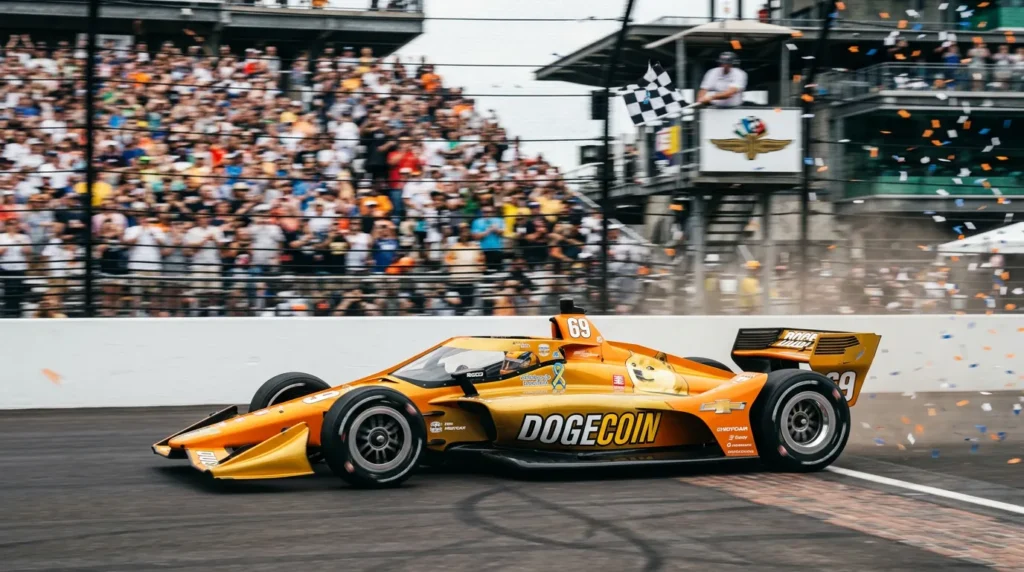
Beyond the regulatory halls of Washington, Dogecoin is making its most prominent appearance yet in the world of professional motorsport. House of Doge, in partnership with the Dogecoin Foundation, has teamed up with IndyCar Series driver Devlin DeFrancesco and the storied Rahal Letterman Lanigan Racing team to bring a fully Dogecoin-branded race car to the 109th Indianapolis 500 — the most iconic single-day motorsports event in the world, drawing more than 350,000 spectators in person and broadcast to audiences in over 140 countries.
The partnership carries a charitable dimension that gives it unusual emotional depth. DeFrancesco was born 15 weeks premature, weighing just one pound at birth, and spent four months in a Neonatal ICU before making a recovery described by his family as miraculous. As a tribute to the medical care that saved his life, DeFrancesco is personally donating $25,000 in Dogecoin to the Riley Children’s Foundation in Indianapolis — which supports one of the nation’s top-ranked neonatology programs.
The community’s response exceeded expectations. A Dogecoin-powered fundraising campaign attached to the partnership raised a total of 117,947 DOGE — approximately $26,000 — from the global Dogecoin community for Riley Children’s Foundation. Every donated DOGE has been directed to Riley Hospital for Children to support NICU babies and children with complex medical conditions.
In an additional commitment to crypto adoption in professional sports, DeFrancesco has agreed to receive $100,000 of his annual racing salary in Dogecoin — a pioneering step for crypto payment integration in IndyCar.
The Fan Vote: Three Liveries, One Doge Legacy
Consistent with Dogecoin’s community-driven ethos, the car’s race livery design was determined by a fan vote. House of Doge and Rahal Letterman Lanigan Racing presented three candidate designs to the community between March 19 and March 25, with fans voting to determine which design would carry the Shiba Inu onto the Indy 500 track. The three options — Blaze, Turbowave, and BananaBoost — each reflected the irreverent, playful character that has defined the Dogecoin brand since its founding. Voters also had the chance to win a Dogecoin wallet loaded with $1,000. The largest community donor was promised an exclusive, race-worn, and personally signed DeFrancesco racing helmet from his Indianapolis 500 qualifying run.
The Indy 500 partnership follows a tradition of Dogecoin community-powered charitable campaigns — from sponsoring the Jamaican bobsled team at the 2014 Winter Olympics to funding clean water projects in Kenya. It demonstrates that DOGE’s community culture, while often expressed through humor and internet memes, consistently translates into tangible, real-world impact when channeled toward a cause.
The Sentiment Paradox: Extreme Fear Meets a 69% Long Majority
Zooming back into the current market, March 12, 2026 presents one of the most analytically interesting sentiment configurations seen for DOGE in recent months — a setup where the headline fear reading and the actual trader positioning are pointing in opposite directions.
The Fear Side
The broader crypto Fear & Greed Index registered a reading of 19 on March 12 — deep in the Extreme Fear zone. The index has remained in distressed territory for an extended period, following what has been a difficult multi-month stretch for the crypto market shaped by macroeconomic headwinds, geopolitical tensions in the Middle East, and the disappointment of X Money’s fiat-only launch announcement. DOGE specifically has experienced:
- $8.32 million in derivatives liquidations concentrated in long positions — suggesting leveraged bulls were forced out of their trades
- Open interest declining 4.83% — confirming a deleveraging phase as traders reduce net exposure
- Five consecutive months of declining market value entering March
- Social media engagement at subdued levels — analytics firms have assigned DOGE a bearish crowd sentiment rating of just 1 out of 5
The Contrarian Positioning Signal
Here is the tension. Despite all of the above, 69.4% of retail traders on Binance — the world’s largest cryptocurrency exchange by volume — currently hold long positions on DOGE. This is not a small or marginal majority. It means that nearly seven out of ten retail traders with active DOGE positions are betting on a price increase, not a decline.
This creates a classic contrarian dilemma. On one interpretation, such a lopsided long majority in an extreme fear environment represents a “wall of worry” that markets can climb — a signal that retail conviction remains intact despite the headline fear, and that any positive catalyst could ignite rapid upside as short-sellers are squeezed. On the other interpretation, a heavily lopsided retail long position is a potential fuel for a further washout — if prices decline further, those 69.4% of long holders face mounting losses, and their forced exits can cascade into additional selling pressure.
Historically in crypto markets, extended periods of extreme fear have coincided with market bottoms — not immediately, but within weeks or months of peak fear readings. The combination of an extreme fear index, a technically forming descending wedge pattern (widely considered a bullish reversal structure), and heavily long retail positioning creates a setup that technical analysts are watching with heightened attention heading into April.
April on the Horizon: Qubic Reveal and Macro Pivots
Several scheduled events in April 2026 are now on the Dogecoin community’s radar as potential market-moving catalysts:
- Qubic mining integration reveal — April 1: The Qubic network, which recently completed its initial ASIC mining integration test with the Dogecoin blockchain, has teased that full technical details of the integration will be officially revealed on April 1, 2026. This announcement will clarify the scope and scale of the new mining capability being added to the network — with the mainnet launch targeting the same date.
- X Money early public access — April: Elon Musk has confirmed that X Money enters early public access in April. While the initial version is fiat-only, the platform’s roadmap is being scrutinized for any hint of future crypto integration. Any official statement from Musk or the X team regarding potential DOGE features — even a vague acknowledgment — would likely trigger immediate market reaction.
- Macroeconomic data flow: U.S. inflation data, Federal Reserve communications, and global risk appetite will continue to shape the macro environment for all crypto assets. The CPI reading released on March 11 and subsequent Fed commentary will set the tone for how risk-on assets — including DOGE — perform heading into Q2 2026.
- Indianapolis 500 — Memorial Day Weekend: The race itself, with its global broadcast footprint and the cultural moment of a DOGE-branded car on the world’s most famous oval, represents a mainstream media visibility event for the coin unlike anything since the peak Elon Musk tweet cycles of 2021.
For a coin whose value has always been deeply intertwined with cultural narrative and community momentum, the convergence of regulatory clarity, charitable visibility at a global sporting event, and a technically compressed price setup makes the weeks ahead some of the most consequential in Dogecoin’s recent history.