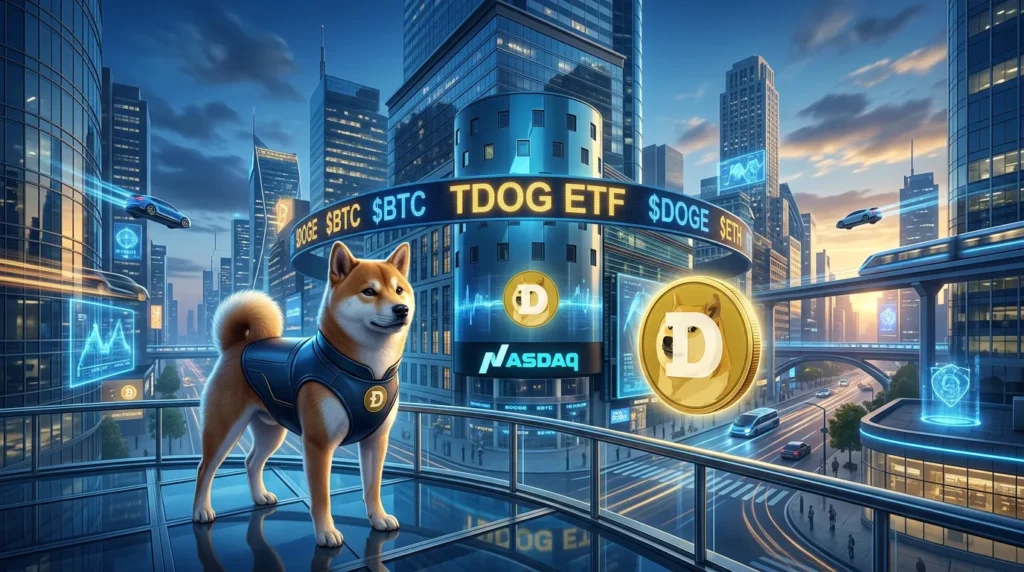
Dogecoin is sending contradictory signals in March 2026. On one side of the ledger: a $28.4 million whale withdrawal from a major exchange, large-holder accumulation of over 138 million DOGE, and a landmark ETF now live on Nasdaq. On the other: daily active addresses have collapsed by 55%, trading volume on some platforms has dropped by half, and the coin continues to drift in a descending price channel against a backdrop of macroeconomic uncertainty and geopolitical tension. Meanwhile, the Dogecoin Foundation is quietly building what could become its most ambitious utility play yet — a Dogecoin-powered rewards debit card accepted at over 150 million merchants worldwide. And a technical milestone from the Qubic network is setting the stage for a new mining integration with a targeted mainnet launch in April.
This is the full picture of where Dogecoin stands right now — and why the diverging signals make it one of the most closely watched assets in the current market cycle.
This article is for informational purposes only and does not constitute financial advice.
The Whale Signal: $28.4 Million Leaves Kraken — What It Means
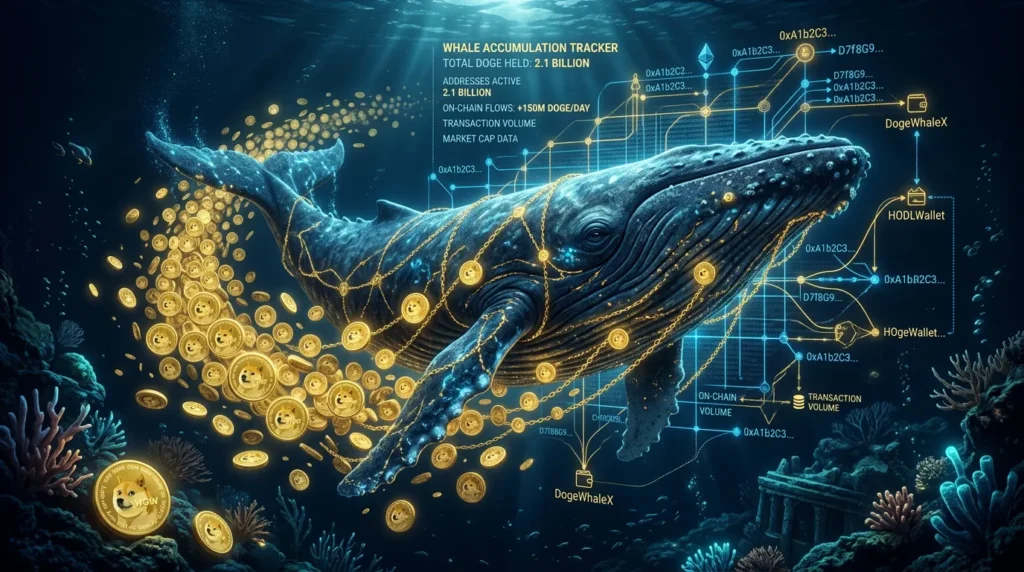
On March 9, 2026, on-chain analytics platform Whale Alert recorded one of the most significant DOGE transactions of the month: a single large holder transferred 314.5 million DOGE tokens — valued at approximately $28.4 million — from the Kraken exchange to an unidentified private wallet address. The transaction was not a sale. It was a withdrawal into self-custody.
In on-chain analysis, the distinction matters enormously. When large holders move coins off exchanges and into personal wallets, it typically signals one of two things: long-term accumulation by an entity that does not intend to sell in the near term, or strategic positioning ahead of an anticipated price event. In either case, it reduces the available liquid supply on exchanges — meaning fewer coins are immediately available for market sellers to push price downward.
Context: Broader Whale Accumulation Trend
The March 9 transaction does not stand alone. On-chain data from recent weeks shows that major DOGE holders — wallets categorized as “whales” by holding large absolute quantities — collectively accumulated approximately 138 million additional DOGE during a period when the coin’s market value experienced a modest 2.96% uptick. This pattern — large holders buying during price weakness — is a classic accumulation behavior observed across all liquid asset classes.
The timing of the March 9 withdrawal also coincided with the scheduled release of the U.S. Consumer Price Index (CPI) report for February on March 11 — a macro data point with direct implications for Federal Reserve policy. A softer-than-expected inflation reading would typically signal a more accommodative rate environment, increasing appetite for risk assets including cryptocurrencies. The withdrawal of 314 million DOGE from exchange supply just ahead of this potential catalyst drew significant attention from traders monitoring on-chain data flows.
The Retail Collapse: 55% Drop in Daily Active Addresses

Here is where the narrative gets complicated. While whales are accumulating and moving coins into cold storage, the broader Dogecoin user base is not showing up. On-chain metrics tell a starkly different story at the retail level:
- Daily active addresses — a key measure of how many unique wallets are transacting on the network — have dropped sharply from approximately 87,700 to 38,700, a decline of over 55% in a relatively short period.
- Trading volume has fallen by approximately 50% on some platforms compared to recent peaks, suggesting that retail traders are stepping back from active DOGE participation.
- Derivatives open interest — reflecting the total value of outstanding futures and options contracts — declined from $1.14 billion to $1.04 billion, indicating that leveraged traders are reducing their exposure.
This divergence between whale behavior and retail participation is one of the defining features of Dogecoin’s current market structure. Large, sophisticated holders are treating prevailing price levels as an opportunity; smaller, retail-driven activity is contracting. Whether retail engagement returns — driven by a macro catalyst, a product launch, or a social media event — is arguably the most critical variable determining DOGE’s next directional move.
Technical Picture: Descending Channel, Neutral RSI, and a MACD Hint
From a pure chart analysis standpoint, Dogecoin is trading within a well-defined descending channel pattern on its daily timeframe, with price hovering near the channel’s midline support zone. According to market analyst Jonathan Carter, this structure typically indicates a methodical downward trajectory — but price stabilization near the channel midpoint can also signal the beginning of diminishing bearish pressure.
- RSI (Relative Strength Index): Currently reading approximately 49.89 — neutral territory. The indicator has recovered from deeply oversold conditions but has not yet crossed the 60 threshold that would indicate established bullish momentum.
- MACD (Moving Average Convergence Divergence): The signal line is approaching a potential bullish crossover. While both MACD lines remain in negative territory, the histogram has flipped to green — indicating that downside momentum is weakening and seller exhaustion may be setting in.
- Key resistance levels to watch: Analysts have identified $0.100 and $0.116 as immediate overhead resistance zones. Beyond those, $0.135 and $0.153 represent the next significant barriers, with $0.182 and $0.206 as upper-range targets if a genuine bullish trend develops.
- Key support: The $0.0875 level has repeatedly acted as a floor for DOGE during the current corrective phase, with buyers consistently stepping in at this zone. A sustained break below it would represent a meaningful deterioration in the technical structure.
The geopolitical backdrop is also weighing on technical setups across the crypto market. Rising tensions in the Middle East have intensified risk-off sentiment among investors globally — a condition that historically amplifies selling pressure in high-beta assets like Dogecoin. Against this environment, the coin’s ability to hold critical support levels while the macro picture shifts is being watched closely.
Dogecoin Foundation’s Rewards Debit Card: Spending DOGE at 150 Million Merchants
While market attention has focused on X Money and the Such app, a third utility initiative is moving forward with potentially broader immediate reach. The Dogecoin Foundation has announced plans to launch a Dogecoin-powered rewards debit card in 2026 — one designed to make DOGE spendable at more than 150 million merchant locations worldwide.
The mechanics of the card are straightforward and designed to remove friction from everyday DOGE spending. When a cardholder makes a purchase, the card automatically converts DOGE held in the user’s balance into the local currency at the point of sale. The merchant receives standard fiat payment — eliminating the need for businesses to manage crypto price volatility, integrate blockchain wallets, or change any aspect of their existing payment infrastructure. From the merchant’s perspective, it is simply a debit card transaction.
Key Features of the Planned Rewards Card
- Global acceptance: Targeting compatibility with the existing card payment infrastructure covering over 150 million merchants — potentially making DOGE one of the most widely spendable cryptocurrencies in real-world commerce if the card achieves meaningful adoption.
- Automatic DOGE-to-fiat conversion: Seamless at-checkout conversion removes the need for users to manually convert crypto before spending, significantly lowering the barrier to everyday DOGE use.
- Cashback and spending rewards: The card is expected to include a rewards structure — potentially cashback in DOGE or points — designed to incentivize usage and build spending habits around the coin.
- Such app integration: The rewards card is expected to operate in conjunction with the Such payments application currently under development by House of Doge, creating a unified interface for managing DOGE balances, card spending, and merchant interactions.
The initiative draws a direct philosophical line back to Dogecoin’s original purpose: not a store of value to be hoarded, but a spendable digital currency for everyday life. The Dogecoin Foundation has not yet disclosed specific details on fee structures, reward rates, or the identity of the card network partner — details that analysts say will be critical in determining whether the product achieves real-world traction.
Notably, the announcement arrives as crypto debit cards are gaining broader regulatory clarity in the U.S. and globally, with tax reporting requirements for crypto transactions being formalized through instruments such as Form 1099-DA. This increased regulatory structure, while adding compliance overhead, also provides a more stable legal foundation for mainstream crypto spending products.
Qubic Network Completes Mining Integration Test — Mainnet Targeting April 2026
Away from the price and product news, a technical development on the Qubic network is drawing attention from the Dogecoin developer and mining communities. Qubic has successfully completed the initial test phase of its planned Dogecoin ASIC mining integration — a milestone that validates the architectural foundation for connecting Qubic’s computational infrastructure with the Dogecoin Proof-of-Work network.
The Qubic team is now preparing for a full-scale launch and has begun engaging the community to identify suitable mining pools for the initial operational phase. The target for mainnet launch is April 1, 2026.
Why This Integration Matters for Network Security
Dogecoin’s security model relies on the Proof-of-Work consensus mechanism, secured by miners running Scrypt-algorithm ASIC hardware. Since 2014, the network has benefited from merged mining with Litecoin, which allows LTC miners to simultaneously secure the Dogecoin blockchain at no additional energy cost — dramatically boosting the combined hashrate available to protect the DOGE network.
The Qubic integration represents a further expansion of this security model, potentially adding new computational resources to the network. As of early 2026, Dogecoin’s network hashrate has reached record levels, fueled by the robust AuxPoW merged mining relationship with Litecoin and the continued deployment of newer-generation Scrypt ASIC hardware such as the Antminer L9.
Broader network security improvements are a foundational requirement for any credible payments infrastructure. A more secure network with higher hashrate makes double-spend attacks progressively more expensive and impractical — a prerequisite for the type of merchant adoption that both the Such app and the rewards card initiative are designed to drive.
Putting It All Together: The Case For and Against DOGE Right Now
Taken collectively, the developments of early March 2026 present a genuinely mixed but structurally interesting picture for Dogecoin:
Bullish Factors
- Significant whale accumulation and large-scale exchange withdrawals reducing liquid sell-side supply
- First physically-backed spot DOGE ETF (TDOG) now live on Nasdaq, opening institutional access channels
- Rewards debit card initiative targeting 150M+ merchant locations — potentially the broadest real-world DOGE utility ever attempted
- Qubic mining integration progressing toward April mainnet launch, strengthening network security
- MACD histogram turning green — a technical signal of diminishing downside momentum
- Potential macro tailwind if CPI data supports a more dovish Fed outlook
Bearish and Cautionary Factors
- Daily active addresses down 55% — retail participation is thin and declining
- Derivatives open interest contracting, signaling reduced conviction among leveraged traders
- Continuous supply expansion of approximately 5 billion new DOGE per year creates structural headwinds
- No confirmed DOGE integration in X Money at launch — a key speculative narrative remains unresolved
- Geopolitical risk-off environment amplifying downside volatility in high-beta crypto assets
- Rewards card and Such app remain unLaunched — utility narrative is forward-looking, not yet live